
Quick answer
Your kitchen cabinet website page should explain refinishing, refacing and full replacement side by side, then let homeowners answer a few questions: are the cabinet boxes sound, is the layout staying, are the countertops staying, and how long can the kitchen be out of use. Show your own price bands and timelines for each, pass the answers into the consultation form, and recommend the option that fits, even when it is the cheaper one.
Key takeaways
- Box condition, layout changes and budget decide most cabinet jobs. Put those three questions on the page in plain words.
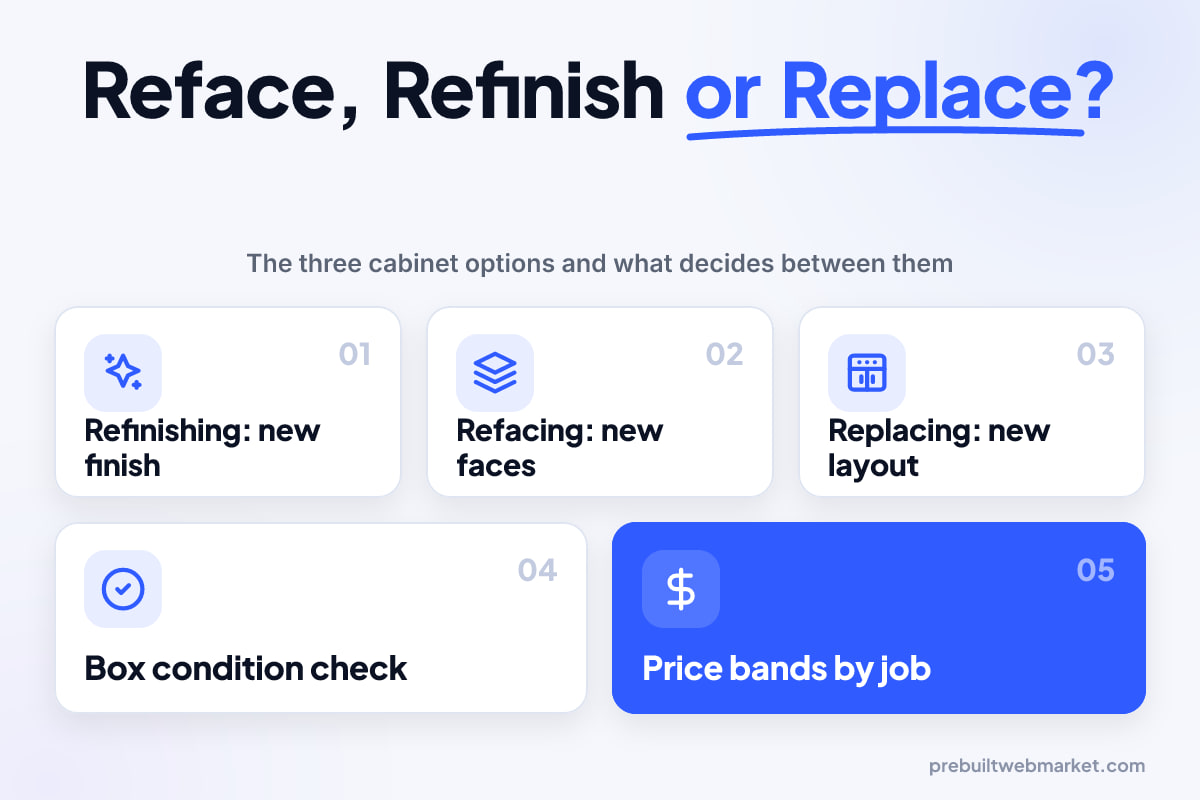
- Refinishing keeps everything and changes the finish, refacing keeps the boxes and changes the faces, replacement changes everything, including the layout.
- Publish price bands and time on site from your own finished jobs, labeled with the year, not national averages or a savings percentage you cannot back up.
- A short self-check with grouped, labeled questions qualifies visitors better than a long form, as long as nothing is pre-selected for them.
- Pass the self-check answers into the consultation request so the first call starts from what the homeowner already told you.
- Lead with the option you do best, but explain the others honestly, including when you would refer the job elsewhere.
In this article
- What your kitchen cabinet website page has to settle
- Refinishing: same cabinets, new finish
- Refacing: new faces on the old boxes
- Replacement: new boxes and a new layout
- The five questions that decide it
- Building the self-check on your website
- Showing time and money without boxing yourself in
- Photos that prove each option
- What to leave off the cabinet page
- Which answer to lead with, by kind of kitchen business
- When the page needs a different answer later
- Putting the decision on your kitchen remodeling website
- Your next step
- Frequently asked questions
The cabinet page on your kitchen remodeling website should help a homeowner decide between refinishing, refacing and full replacement before they ever book a consultation. Your kitchen cabinet website page does that by explaining each option fairly, asking the three questions that decide most jobs (are the boxes sound, is the layout staying, what is the budget), and recommending the option that fits.
It matters because cabinets are where kitchen budgets go wrong in both directions. A homeowner with solid 1990s maple boxes and a layout they love is told by a friend that they need a full remodel, assumes it is out of reach and never calls. Another, with a swollen sink base and a wall they want gone, books a refacing consultation and is disappointed when you explain why it will not work. A page that sorts these people out in advance saves your evenings and their goodwill.
What your kitchen cabinet website page has to settle
Your kitchen cabinet website page has to settle one question for every visitor: which of the three cabinet routes is realistic for my kitchen, my budget and my patience? Everything else on the page, from photos to the booking button, supports that answer.
Most visitors arrive with a half-formed view: refacing is always the clever choice, painting is a weekend job, or tired doors mean new cabinets. Your page is the first place they meet someone who knows the difference. It sits alongside the gallery, countertop and financing pages covered in our Delaware kitchen remodeling website guide; this article stays on the cabinet decision.
Why the decision belongs on the website, not only in the consultation
You will still confirm everything in person. But a homeowner who has read the three options and checked under their sink arrives ready to talk scope and money, and the quote is closer to what they expected.
Refinishing: same cabinets, new finish
Refinishing keeps every part of the existing cabinets and changes only the finish: the doors, drawer fronts and frames are cleaned, prepared and repainted or restained, usually with new hinges and handles. It is the lightest of the three routes, and often the right one.
Who refinishing suits
Refinishing suits homeowners whose cabinets are structurally sound, whose layout works, and whose real complaint is color. Think of the solid oak kitchen from the 1980s or 1990s that is simply orange, or the builder-grade white cabinets that have yellowed. A new finish and new hardware can change the room without touching the countertops, the plumbing or the floor.
It also suits people living in the home, because doors often go off site to be sprayed and the kitchen stays usable for most of the job.
Where refinishing struggles
Refinishing struggles with surfaces that do not take a new finish well, such as peeling thermofoil, chipped laminate or doors with water damage. It also cannot change the door style: a raised-panel door painted white is still a raised-panel door. If the homeowner hates the shape, refinishing will disappoint them however good the paintwork, and your page should say so.
What the page should say about time and cost
Give a time on site from your own recent jobs, stated as a range for a typical kitchen, and the main things that change it: the number of doors, whether there is an island, the existing finish and how much repair is needed first. Give a price band in the same way. If you have done twelve refinishing jobs in the last two years, those twelve invoices are the only honest source for that band.
Refacing: new faces on the old boxes
Refacing keeps the existing cabinet boxes and replaces everything the homeowner sees: new doors and drawer fronts, a new veneer or laminate skin over the frames and exposed ends, and new hinges and handles. The layout stays exactly where it is, and in most cases so do the countertops.
Who refacing suits
Refacing suits homeowners who like where everything is but want a different look, including a different door style, which refinishing cannot give them. It suits kitchens with good stone countertops that the owner does not want to lose, and households that cannot be without a kitchen for long.
Refacing can also absorb small changes. You can usually replace one damaged sink base, add a pantry cabinet at the end of a run, or swap a stack of doors for deep drawers, without rebuilding the whole kitchen. Say so on the page, because many homeowners assume refacing is all or nothing.
Where refacing struggles
Refacing struggles when the boxes are not worth keeping: swollen particleboard under the sink, sagging shelves, cabinets that have racked out of square, or uppers that are too short for the ceiling. Putting new doors on failing boxes produces a kitchen that looks new for a year and then behaves like the old one.
It also does nothing for the layout. If the homeowner wants to move the sink to an island, take out a wall or change the work triangle, refacing is the wrong conversation, and your page should say that directly.
Frameless and framed cabinets are different jobs
Refacing frameless, European-style cabinets is mainly a door and drawer front replacement, because there is no face frame to skin. Homeowners rarely know which type they have, so a pair of labeled photos, one framed and one frameless, answers it in seconds. Each of our kitchen remodeling website demos has a dedicated Cabinets page, which is where photos like these belong.
Replacement: new boxes and a new layout
Replacement removes the old cabinets entirely and installs new ones, which is the only route that lets the homeowner change the layout, the cabinet sizes or the height of the uppers. It is the biggest of the three jobs, and the right one when the boxes have failed or the room itself has to change.
Who replacement suits
Replacement suits homeowners who want to move things: an island added, a peninsula removed, the range on a different wall, a wall opened to the dining room. It suits kitchens with failed boxes, and owners who plan to stay long enough that new construction throughout is worth the cost and the disruption.
It is also the honest answer when half the boxes need replacing anyway, and your page can say so without sounding like an upsell.
What replacement drags in with it
Replacement rarely stops at cabinets, and your page should be clear about that. New boxes usually mean new countertops, because tops rarely survive removal or fit a new layout. Moving the sink or range brings plumbing, electrical and venting work, and with them permits and inspections in most places. Flooring often has gaps where old cabinets stood, and walls need patching and paint.
Listing this on the page means the number in your quote is not the first time a homeowner hears about the full scope.
What the page should say about time
Replacement takes the kitchen out of use for weeks, not days, and new cabinets often have a lead time before work starts. Show both numbers from your recent jobs: the gap between design sign-off and demolition, and the time from demolition to a working kitchen. They are different, and confusing them causes real frustration. If you help clients set up a temporary kitchen, say so here.
The five questions that decide it
Five questions decide almost every cabinet job: whether the boxes are sound, whether the layout is staying, whether the countertops are staying, how long the kitchen can be out of use, and how long the owner plans to stay. Put them on your website in that order, in plain words, because the first two rule out options and the last three choose between what is left.
Are the cabinet boxes sound?
This is the question that rules refacing and refinishing in or out. Give homeowners a short checklist they can do themselves with a flashlight and five minutes:
- Under the sink. Look for swollen, soft or flaking panels, water stains and a cabinet floor that gives when pressed.
- The shelves. Check whether shelves sag or the shelf pins have pulled out of the sides.
- Doors and drawers. Open every one. Doors that will not line up and drawers that bind can mean the box has moved out of square.
- Next to the dishwasher and range. Heat and steam damage often shows on the panels beside them first.
If the answer to most of these is “fine”, refacing and refinishing are both on the table. If the sink base is the only problem, refacing with one replacement box may still work. If several boxes have failed, replacement is usually the honest answer.
Is the layout staying?
If anything is moving, whether that is the sink, the range, a wall or an island, the answer is replacement. Put it second and make the consequence clear in the result.
Are the countertops staying?
Homeowners with good stone or quartz countertops often do not want to lose them, and refacing or refinishing usually lets them keep their tops. Asking this question also surfaces the hidden cost of replacement for people who had not thought about it.
How long can you be without a kitchen?
A household with young children, a home office or no second sink will weigh days against weeks very differently from a retired couple who can eat out. Ask it as a simple choice of ranges rather than an open question.
How long will you stay in the home?
Someone selling within a couple of years is often best served by a clean refinish. Someone staying twenty years who wants the kitchen to work differently has a stronger case for replacement.
Building the self-check on your website
The self-check on your website should be a short set of grouped questions, each with a few labeled choices, that produces a likely answer and leads straight to the consultation request. It should take under a minute on a phone and never feel like a test.
Ask each question as a labeled group of choices
Each question works best as a radio group: a visible question with three or four answers beneath it, of which the homeowner picks one. MDN’s reference for radio inputs describes these as “collections of radio buttons describing a set of related options”, where “only one radio button in a given group can be selected at the same time”, and its own example wraps each group in a fieldset with a legend. That is the structure to ask your developer for.
The W3C’s guidance on Labels or Instructions explains why the question text matters as much as the choices. For radio buttons, “each choice will need a label”, and when the choices alone do not convey the purpose of the group, “authors do need to provide an overarching label, legend or instructions”. “Yes”, “No” and “Not sure” mean nothing without the question above them, and the same guidance warns that “too much information or instruction can be just as harmful as too little”.
Do not pre-select an answer
MDN also notes that it is usually wise to have one radio button default to checked, because a form rarely makes sense with nothing selected. A diagnostic self-check is the exception. If “My cabinet boxes are in good condition” is ticked when the page loads, some homeowners will skim past it, and the result will recommend refacing to someone with a rotten sink base. Leave every question blank and require an answer before showing the result.
Add a “Not sure” choice to the box condition and countertop questions. A homeowner who is not sure has told you something useful: they need the in-person check, and your result should say so rather than guess.
Write the result as a recommendation, not a verdict
The result should name the likely option, give one or two sentences on why, show your time and price band for it, and offer the next step. An illustrative result might read: “Refacing is likely to suit your kitchen. Your boxes sound solid and your layout is staying, so new doors and drawer fronts can change the look without replacing your countertops. Our recent refacing jobs took one to two weeks on site. Book a visit and we will check the boxes and confirm.”
When the answers point two ways, say so: “refacing or replacement, depending on the sink base” is more honest than forcing one answer.
Hide the long explanations until someone asks
Some homeowners want the detail behind each question, such as how you check a sink base or why frameless cabinets reface differently. Put that detail in expandable sections beneath each question rather than in the main flow. MDN’s guide to the details element describes it as a disclosure widget “in which information is visible only when the widget is toggled into an open state”, with a summary as the label. It works without any scripting.
Send the answers with the booking
The consultation request that follows the result should carry the self-check answers and the recommendation with it, so your designer reads them before the visit. Ask only for what the self-check did not: name, phone, email, ZIP code, and a preferred time. Do not ask them to describe their kitchen again in a blank text box.
If you want those answers to land in a pipeline, with an automatic text confirming the visit and a reminder the day before, our GoHighLevel CRM service handles that from the website form.
Showing time and money without boxing yourself in
Show a price band and a time-on-site range for each option, built from your own recent jobs and dated, with the things that push a job up or down listed beside them. Leaving money off the cabinet page does not stop homeowners comparing; it only means they compare you with a guess.
Build each band from your own invoices
Take your last ten or twenty jobs of each type and look at where most of them landed, ignoring the one enormous outlier. That spread is your band. State what kind of kitchen it describes, for example “a typical kitchen with 25 to 35 doors and drawer fronts”, and what it includes and excludes, such as countertops, hardware, appliances and installation. Note the year, so a figure from 2025 is read as a 2025 figure.
If you do not have enough jobs of one type for an honest band, say “priced after a visit” and explain what drives the cost, rather than borrowing a figure from elsewhere.
List what moves the number
Next to each band, list the four or five things that most change the price on your jobs: kitchen size, door style, the finish chosen, boxes that need replacing, an island, and any plumbing or electrical work. Homeowners can then place their own kitchen in your range.
Photos that prove each option
Every option on the page needs its own before and after photos, taken from the same angle and tagged with the route you used, because homeowners decide by seeing a kitchen like theirs that went the way they are considering. For refinishing and refacing, a matched pair proves the layout stayed; for replacement, it shows what moved. Make the before photo a step on every job sheet.
Describe what changed in the alt text
The W3C’s explanation of Non-text Content says its intent is “to make information accessible through the use of a text alternative”, so that “people who cannot see a picture can have the text alternative read aloud”. For cabinet photos, the information is the change. “Kitchen after” helps nobody. “The same kitchen after refacing: oak raised-panel doors replaced with white shaker doors, countertops and layout unchanged” carries the whole point of the photo.
Tag the gallery by option
Tag every kitchen in your gallery as refinished, refaced or replaced, and link each option’s section on the cabinet page to its filtered gallery view. Our guide to portfolio filters renovation buyers use covers how to set up project types and tagging rules so those links stay reliable.
Do not rely on color to show what fits
It is tempting to show three option cards with green ticks and red crosses for “suits” and “not for”. The W3C’s guidance on Use of Color notes that “many older users do not see color well”, and asks for “information in addition to color, such as shape or text”. Kitchen remodeling customers include plenty of older homeowners. Use the words “Suits you if” and “Not for you if” as headings, and let color be decoration.
What to leave off the cabinet page
Leave off anything that sounds persuasive but does not help a homeowner choose. Each of the items below appears on plenty of cabinet pages and makes the decision harder.
- Savings percentages you did not calculate. A national-sounding figure for how much refacing saves is not your price.
- Trade terms without a definition. Face frame, carcass, overlay, thermofoil and inset are fine once explained, and confusing otherwise.
- A single “Get a free quote” button for all three options. Separate the starting points, or pass the chosen option into one form.
- Countdown offers. A cabinet decision takes weeks of discussion between two people. Pressure on the page makes the visit harder, not easier.
- Old safety assumptions. Sanding and repainting old finishes can raise safety questions in older homes, including lead-safe work rules for paid work on painted surfaces. Do not make claims about them from memory; check the current federal and state requirements and describe your process accurately.
Which answer to lead with, by kind of kitchen business
Lead with the option you do best and explain the other two honestly, including when you would send the job elsewhere. The emphasis changes by business, but all three options always appear, because the homeowner is choosing between them anyway.
Design-build remodelers who mainly do full kitchens
Lead with replacement, because layout change is your strength, and explain refacing and refinishing in a short, fair section that says who they suit. If you do not offer them, say so and, if you have one, name a trade you trust. A homeowner you sent to a refacing company is the one who calls you when the next house needs a full remodel.
Refacing specialists
Lead with refacing, but put the box-condition checklist at the top of the page, not the bottom. Your biggest risk is consultations for kitchens that cannot be refaced, and an honest checklist is the cheapest filter you have. Be explicit about the small changes you can include, such as a replacement sink base or drawer conversions.
Custom cabinet shops
Lead with replacement and the craftsmanship behind it, since a shop that builds its own boxes sells precisely what the other two routes keep. The Hearth and Grain Kitchens demo, set in Madison, Wisconsin, shows a website for a business that makes its cabinetry in-house and installs it with the same crew. A shop like that can also offer replacement doors and drawer fronts for refacing, and the page should say so if it does.
Cabinet painting and refinishing crews
Lead with refinishing and be precise about what it can and cannot change. Your most valuable section is “When refinishing is not enough”, because it stops door-style and box-condition complaints before you start work. If you partner with a refacing or remodeling company for those jobs, say so.
Remodelers in neighborhoods of older homes
Lead with the decision itself. Older homes often hold solid-wood cabinets worth keeping next to kitchens patched decades ago, so give the box-condition questions extra detail and explain how you handle old finishes safely.
When the page needs a different answer later
The cabinet page needs a different answer whenever your services, your prices or your lead times change, and the self-check makes it easy to see when that has happened. Review it twice a year, update the bands and the year beside them when prices or lead times move, and revisit it at once when you add or drop an option.
When you add or drop an option
If you stop offering refacing, keep the explanation and change the result for that route to a clear referral or a note that you do not offer it. Deleting the section entirely leaves homeowners with a two-option page that quietly pushes them toward the bigger job, and they notice. If you start offering it, add the section, the photos and a band only once you have finished enough jobs to build one honestly.
When the answers tell you something
Record which result each visitor gets and which results lead to bookings. If many get “refacing” and few book, your band or your result text needs work. If “Not sure” is common on box condition, add a better photo guide to that question.
Putting the decision on your kitchen remodeling website
You can add all of this to the site you already have: the self-check and option sections are a modest job for a developer on most platforms, and the written content is yours to draft either way. If you are weighing a rebuild against adding to your current site, our comparison of website options sets out the trade-offs between DIY builders, WordPress, freelancers, agencies and prebuilt designs fairly.
If you are starting fresh, every prebuilt kitchen remodeling website from us already has Cabinets and Countertops pages, before and after sliders, a budget estimator and showroom booking. The Nordhaus Kitchen Studio demo, set in Portland, Oregon, shows a cabinet and stone business presented around measured surveys and drawings. Plans start at $97 a month with a $297 setup fee, launch within 7 business days of receiving your content and come with a 30-day money-back guarantee on the first month; the details are on our plans and pricing page.
Your next step
Pull your last twenty cabinet jobs and sort them into refinished, refaced and replaced. For each group, note the price range, the time on site and whether you have a before photo from the same angle as the after. That one list gives you the bands, the timelines and the gallery for the page, and shows you which option you can explain best today.
If you would like help turning that list into a cabinet page and self-check, book a free 45-minute call and we will work through it with you.
Sources
Frequently asked questions
Should a kitchen remodeling website show prices for cabinet refacing?
Yes, as a band rather than a fixed figure. A band built from your own recent refacing jobs, such as a range for a typical kitchen of a stated size, tells homeowners whether refacing is in reach. Say what is included, what pushes the price up, and the year the band was last updated, so nobody reads an old figure as a quote.
What if I only do full kitchen remodels and do not offer refacing?
Explain all three options anyway and say plainly which ones you do. A homeowner with sound cabinets and a layout they like will find refacing somewhere else whether you mention it or not. Telling them when replacement is genuinely worth it, and when it is not, builds the trust that brings them back for the bigger job or a referral.
How do homeowners know if their cabinet boxes are good enough to reface?
Give them a short checklist they can do with a flashlight: look under the sink for swollen or soft panels and water stains, check whether shelves sag, open every door and drawer to see if the boxes are square, and press on the cabinet floors. Any of those problems usually points toward replacing at least some boxes. Then confirm in person.
Is cabinet painting the same as refinishing on my website?
Customers often use the words loosely, so define them once on the page. Refinishing usually means cleaning, preparing and repainting or restaining the existing doors, drawer fronts and frames. Refacing means new doors and drawer fronts with a new skin over the frames. Use the same definitions on every page, in every quote and on the phone.
Where should the reface or replace decision go on my website?
Put the full explanation on your Cabinets page, with a short version and a link on your Kitchen Remodels page and your pricing or financing page. The self-check belongs near the top of the Cabinets page, with its result leading straight to the consultation request. Link to it from gallery projects tagged by option so visitors can see examples.
Will a self-check put people off booking a consultation?
Not if it is short and its result is a recommendation rather than a rejection. Four or five questions take under a minute. The result should say what is likely to suit them, what it usually costs and takes with you, and invite them to book a visit to confirm. Visitors who would never have booked are rarely lost; poor-fit bookings are what it filters.
Do I need different photos for refacing and replacement jobs?
Yes. Tag every gallery project with the option you used and show the before shot from the same angle as the after. A refacing job should show that the layout stayed the same; a replacement job should show what moved. Homeowners trust a side-by-side comparison of their own kind of job more than a showcase of your most expensive kitchen.