
Quick answer
Explain every estimate type you offer on your website in one plain paragraph: what the number covers, what can change it and what the customer pays at delivery. Put a short version beside the quote form, a fuller one on the quote page, and repeat the type on the written estimate. Confirm interstate rules with the FMCSA before publishing them.
Key takeaways
- Customers rarely know the difference between estimate types, so define each one in a sentence before you use the term.
- Describe what the customer pays at delivery for each type. That one sentence prevents more disputes than any paragraph about your service.
- Only list the estimate types you actually issue, and say which moves each one is for: local hourly, long distance or commercial.
- Name the things that change a quote, such as added items, stairs, long carries and access problems, before the customer books.
- Keep federal and state rules off the page unless you have checked the current wording with the regulator; explain your own process instead.
- Use the same estimate names on the website, the form, the confirmation email and the paperwork.
In this article
- How to use this guide to moving company website estimates
- Binding estimates
- Non-binding estimates
- Not-to-exceed estimates
- Hourly rates for local moves
- Flat-rate and all-inclusive quotes
- Ballpark ranges and online calculators
- The survey behind the estimate
- Changes on moving day
- Writing estimate types into your movers website
- What to leave off the estimate pages
- Which ones you need first
- Questions to ask your web provider about the quote page
- Your next step
- Frequently asked questions
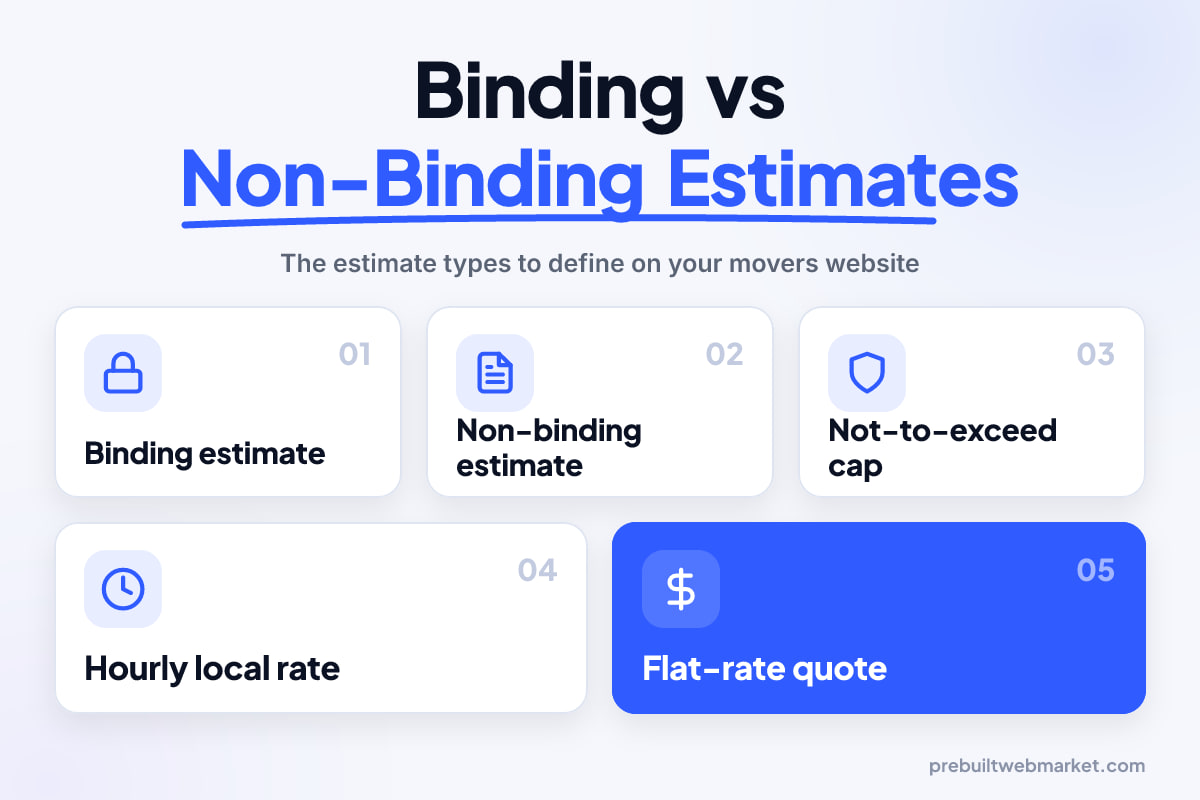
The moving company website estimates that customers understand are the ones explained in one plain paragraph each: what the number covers, what can change it, and what the customer pays when the truck arrives at the new home. Binding, non-binding and not-to-exceed are the three names that matter most, and your quote page should define every one you use before the customer ever sees a figure.
This matters more for movers than for almost any other trade. A customer is handing you everything they own, often on a date they cannot move, and the stories they have heard are about a low quote that doubled on the day. Most of those disputes start with a misunderstanding about what kind of estimate was given. A website that explains the terms honestly prevents the argument before the survey, filters out the customers who only want the lowest headline number, and gives your crew something clear to point to on moving day.
How to use this guide to moving company website estimates
This guide is a reference: one section for each estimate type or pricing term your customers will meet, so you can decide which ones belong on your movers website and brief any web provider with confidence. Each entry says what the term means in plain language, which moves it suits, and what a good explanation on your site looks like.
Read the entries for the estimates you actually issue and skip the rest. A local mover that works on hourly rates needs the hourly entry, the changes entry and probably the ballpark entry. A long-distance carrier needs binding, non-binding and not-to-exceed, plus the survey entry. A commercial relocation firm needs fewer definitions and more about scope.
Two warnings before you start. First, this is about how to explain your process on a web page, not legal advice. Interstate household goods moves in the United States are regulated by the Federal Motor Carrier Safety Administration (FMCSA), and moves within a state are regulated by that state, so confirm the current rules with the right regulator before you put any rule on your site. Second, the words on your website must match the words on your paperwork. If the site says “binding” and the estimate form says “fixed price”, a customer in a dispute will read that as two different promises.
Binding estimates
A binding estimate is a price that stays the same for the items and services it lists, whether the shipment ends up heavier or lighter than expected. It is the type customers most want and least understand, because they assume “binding” means the price can never change for any reason.
What it covers and what it does not
The honest explanation has two halves. The price is locked for the inventory and services written on the estimate. If the customer adds a sofa, a garage full of boxes or a second pickup address, or asks for packing that was not quoted, the estimate no longer describes the job, and the mover will usually need to issue a revised estimate before loading. Your website should say both halves in the same paragraph, because the second half is where the arguments happen.
A good explanation on a quote page reads something like this illustrative wording: “A binding estimate is a fixed price for the items and services listed on it. If the shipment weighs more than we expected, you pay the same. If you add items or services before moving day, we will give you a revised written estimate before we load, so you always know the price first.”
When to offer it
Binding estimates suit long-distance and interstate moves where a proper survey has been done, because the mover carries the risk of a heavier load. They also suit customers with relocation budgets and fixed employer allowances, who need a number that will not move. If you only offer binding estimates after an in-home or video survey, say so on the page and in the form, so nobody expects one from a two-minute online request.
What good looks like on the page
Lead with the benefit, then the condition: “You know the price before we arrive” followed by “for the inventory we agree together.” Put the condition in normal text, not a footnote. The Nomad Long Distance Movers demo, set in Louisville, Kentucky, is a useful example of a long-distance site that makes binding estimates part of the headline offer rather than a line in the terms.
Non-binding estimates
A non-binding estimate is the mover’s best calculation of the final cost, based on the expected weight or time and the services requested, and the final bill can come in higher or lower. For interstate moves the final charge is usually based on the actual weight of the shipment.
The sentence customers need
The single most useful sentence on this entry is what the customer pays at delivery if the final figure is higher than the estimate. For interstate household moves, federal rules limit how much a mover can require at delivery when the charge comes in above a non-binding estimate. Do not paraphrase that rule from memory or from another mover’s site. Check the current wording on the FMCSA’s consumer pages, then either describe it accurately with the date you checked it or say “federal rules protect you at delivery; you can read them on the FMCSA website.”
For moves within your state, your state regulator may have its own rules for non-binding or hourly estimates, and some states differ a lot from the federal approach. If you cannot state the rule with confidence, describe your own policy instead: when you will contact the customer if the job is running over, and how they can pay.
When to offer it
Non-binding estimates suit moves where the inventory is uncertain, such as a customer who has not yet decided what to sell, or a move booked before a survey is possible. They usually produce a lower headline number than a binding estimate for the same move, which is exactly why they cause trouble when customers compare quotes side by side.
What good looks like on the page
Say plainly that the number can go up or down and why: “We charge for the actual weight of your shipment, so if you move more than we expected, the price rises, and if you move less, it falls.” Then add one sentence about what you do to keep it accurate, such as a video survey or a room-by-room inventory. A non-binding estimate described honestly is not a weakness. A non-binding estimate presented in large type as “your price” is the thing that ends up in a complaint.
Not-to-exceed estimates
A not-to-exceed estimate sets a ceiling: the customer pays the lower of the estimated price and the price based on the actual weight or time, and never more than the ceiling for the inventory listed. Many movers call it “binding not-to-exceed” or “guaranteed not to exceed”, and the names vary between companies.
Because the term is used loosely across the industry, the definition that counts is the one in your own contract. Read it, then write the website version to match it word for word in meaning. If your contract says the ceiling applies only to listed items, the website must say that too.
When to offer it
Not-to-exceed estimates are the strongest offer for a customer who is nervous about price. They are often worth leading with on a long-distance page, because they answer the worry most customers bring to a moving website: “will the price go up?” They do carry more risk for you, so only offer them where your survey process is good enough to price the ceiling accurately.
What good looks like on the page
Explain it with an illustrative example, clearly labelled as one: “If your estimate is $3,000 and your shipment comes in lighter, you might pay $2,700. If it comes in heavier, you still pay $3,000 for the items listed.” Numbers make the idea click faster than a definition does. Avoid “guaranteed lowest price” or similar claims next to it, which are a different promise entirely.
Hourly rates for local moves
An hourly quote is a price per hour for a crew and truck, plus any fixed charges, and the final bill depends on how long the job takes. Most local moves are priced this way, and it is the pricing method customers most often misread, because they multiply the rate by their own guess at the hours.
What the customer needs to see
An hourly entry on your website should list every part of the bill in one place:
- The crew size and the rate for that crew, for example a three-person crew and truck.
- Any minimum number of hours.
- How travel time or a trip charge is worked out.
- When the clock starts and stops.
- What is charged separately, such as packing materials, heavy items or stairs above a certain number of flights.
- Whether weekends, evenings or peak dates cost more.
The Little Box Movers demo, set in San Diego, California, shows this well: it is built for an hourly mover and puts upfront fees and a cube-sheet builder in front of the customer before they request a quote.
Where hourly quotes cause disputes
Hourly disputes are usually about the start time, travel time and slow loading caused by a customer who was not packed. Your page should say what happens if boxes are not packed when the crew arrives: whether the crew packs them at the hourly rate, and what that costs. One honest sentence about it is better than an argument at 9 in the morning.
Flat-rate and all-inclusive quotes
A flat-rate quote is a single price for a defined job, and it is the local equivalent of a binding estimate. Some local movers use it for small, predictable moves such as a studio apartment, and some use it for commercial jobs with a fixed scope.
The trap is the word “all-inclusive”. If the flat rate excludes stairs, long carries, packing materials or a second stop, the word is untrue, and customers will remember it. Name the inclusions in a short list instead: crew, truck, fuel, blankets, basic furniture disassembly and reassembly, and whatever else you really include. If you do not offer flat rates, do not use the term on your website at all, because customers will ask for one on the phone.
Ballpark ranges and online calculators
A ballpark range is a rough figure given before any survey, usually from an online calculator or a quick phone call, and it is not an estimate of any type. Many moving sites now show one, and it can be useful, as long as the customer knows exactly what it is.
Ranges, not single numbers
A range is more honest than a single figure, because it shows that the price depends on details you do not know yet. “Most two-bedroom local moves we do fall between $X and $Y” tells a customer more than “from $X”, and it does not set a false anchor. Fill in real ranges from your own past jobs, and update them when your rates change.
If you publish ranges in structured data for search engines, Schema.org’s maxPrice property is defined as “the highest price if the price is a range”, with a matching minPrice, so a range can be marked up as a range rather than a single misleading figure. Only mark up numbers that are visible on the page.
What to say next to the calculator
Put one sentence directly under the result: “This is a rough range, not an estimate. Your written estimate follows a video or in-home survey.” Then make the next step obvious, such as booking the survey or calling. A calculator that ends with a big number and nothing else teaches the customer to shop on that number.
The survey behind the estimate
The survey is how the mover learns what is being moved, and the type of survey decides which estimate types you can responsibly offer. Customers do not always see the link, so your website should make it.
In-home and video surveys
An in-home survey means someone from your team walks through the home and lists what will move. A video survey does the same on a phone call, with the customer showing each room. Both let you issue binding or not-to-exceed estimates with confidence. Your quote page should say which surveys you offer, how long they take and what the customer should have ready, such as cupboards open and the garage accessible.
If you handle interstate moves, check the FMCSA’s current requirements for surveys before you describe your survey process on your site.
Inventory lists and cube sheets
An inventory list is the room-by-room record of items, and a cube sheet turns it into an estimated volume or weight. If your form lets customers build their own inventory, tell them that the estimate is only as accurate as the list, and give them a simple way to add the things people forget: the shed, the attic, the bikes and the boxes already packed in a spare room.
What to ask on the form
Your estimate form decides how accurate the estimate is. Ask for the details that change the price, in short steps: dates, both addresses, home size, stairs and elevators at each end, how close the truck can park, packing, and any very heavy or fragile items. The W3C’s guidance on labels and instructions for form inputs puts the goal simply: users should know what information to enter. For a moving form, that means each question explains why it is asked when the reason is not obvious, such as “Parking distance changes how long loading takes.”
Our guide to following up on movers website leads covers what happens after the form is sent, which is where many quotes are won or lost.
Changes on moving day
Changes on moving day are anything that makes the job different from the one estimated, and they are the reason any estimate type can end up with a different total. A section on your quote page that names them in advance is the most useful dispute prevention you can publish.
The usual causes
Write a short list of the changes you actually see, with what each one means for the price:
- Items added after the survey, including things that were missed in a shed, attic or storage unit.
- Access that was not described, such as extra flights of stairs, an elevator that was not booked or a long walk from the truck.
- A second pickup or drop-off address.
- Packing that was not quoted because boxes were not ready.
- A shuttle, which is a smaller truck used when a large one cannot reach the home.
- Waiting time, such as a closing that runs late at the new home.
How you handle a change
Say what you do when a change happens. For example: “If the job has changed from your estimate, our crew lead will explain the difference and give you the revised price in writing before we load anything extra.” If you have a policy for binding estimates, such as reaffirming the original price or issuing a revised one, describe it exactly as your contract does.
Writing estimate types into your movers website
The estimate explanations belong in four places on your movers website, each with a different length: next to the form, on the quote page, in the FAQ and in the confirmation. Repeating the type in all four is what makes it stick, and it is one of the places where good movers website design is about words rather than looks.
Beside the form
Next to the quote form, one line per estimate type is enough, with a link to the fuller explanation: “Long-distance moves get a binding estimate after a free video survey. See how our estimates work.” Customers are filling in a form, not reading an essay, so keep it short.
On the quote page
The quote page, often called “Get a Quote” in the navigation, is where each estimate type gets its full paragraph. Use one H2 or H3 per type so customers can scan for the one they were given. If the page is long, a disclosure widget can help: MDN’s documentation of the HTML details element explains that it creates a widget whose content is visible only when opened, with a summary as its label. That keeps the page tidy, but put the one-line definition in the summary itself, so a customer who never taps it still sees what the term means.
Define every term the first time
The W3C’s guidance on defining unusual words recommends providing definitions for jargon and unusual terms, and it encourages this for specialised information written for non-specialist readers. Moving pages are full of terms like valuation, shuttle, long carry, accessorial charges and tariff. Define each one in the sentence where it first appears, or leave it off the customer page. The same goes for abbreviations: the W3C’s guidance on expanding abbreviations asks for a way to find their expanded form, so write “United States Department of Transportation (USDOT) number” the first time, then “USDOT number” after.
Let customers check before they commit
When a customer accepts an estimate online or books a move, they are making a financial commitment. The W3C’s success criterion on error prevention for legal and financial submissions asks that such submissions are reversible, checked for input errors, or reviewable and correctable before they are finalised. For a moving site, that means a review step that shows the dates, addresses, inventory summary and estimate type before the customer confirms, and a clear way to change them. It also means the confirmation email repeats the estimate type by name.
You can see how these pieces fit together on a full site in our movers website demos, which include a multi-step estimate form, separate local and long-distance pages and a licence trust bar.
What to leave off the estimate pages
Some content does more harm than good on a page about moving company website estimates. Leave these off:
- Rules you have not checked. Federal and state rules change, and a wrong rule on your site is worse than none. Explain your process and link customers to the regulator.
- Estimate types you do not issue. Every term on the page is a promise a customer can ask for.
- “Guaranteed lowest price” and “no hidden fees” without proof. If the price can change on the day for any reason, “no hidden fees” needs the reasons listed beside it.
- A single “from” price with no range. It sets an anchor you will not meet for most moves.
- Long legal text pasted from your contract. Link the full terms, then explain the parts that matter in plain words.
- Attacks on other movers. You can warn customers to compare like with like without naming anyone.
Which ones you need first
Start with the estimate types you issue most and the changes section, because those cover most of the questions you get on the phone. A practical order:
- The changes-on-moving-day section. Every mover needs it, whatever pricing you use.
- Your main pricing method. Hourly for most local movers; binding or not-to-exceed for most long-distance movers.
- The survey entry, so customers know how the estimate is built and what to have ready.
- Non-binding, if you issue it, with the delivery-payment sentence checked against the regulator.
- Ballpark ranges, only if you show a calculator or ranges.
- Flat rate, only if you sell it.
If you serve both local and interstate moves, keep the two explanations on their own service pages as well as the quote page. A Charlotte apartment move and a move to Denver are bought by different people with different worries, and the Washington movers website guide shows how to split local, long-distance and permit details for one state.
Questions to ask your web provider about the quote page
Whoever builds or edits your website should be able to answer these questions about how the estimate content will work. If they cannot, the explanations you write may end up hidden, inconsistent or out of date.
- Can each estimate type have its own heading on the quote page, so customers can find the one they were given?
- Can the form show a one-line explanation of the estimate type next to the relevant step, and change it for local and long-distance moves?
- Does the form have a review step before submission, and does the confirmation email repeat the estimate type and details?
- If I show a calculator or ranges, is the “rough range” label inside the result box?
- Is any price markup in the page’s structured data limited to figures that are visible on the page, using a range where the price is a range?
- How quickly can I change the wording if my contract or the regulations change, and is that included in my plan?
- Will my USDOT number and any state permit appear on every page, including the quote page?
For the last point on cost and edits, it helps to know what you are comparing. Our comparison of website options sets prebuilt sites against DIY builders, WordPress, freelancers and agencies. If you choose a prebuilt movers website from us, the Launch plan is $97 a month plus $297 setup and includes 3 content edits every month, which covers wording changes like these; all three are on our plans and pricing page.
Your next step
Reread your estimate and contract templates, list the estimate types you actually issue, and write one plain paragraph for each, plus a list of what can change the price on the day. Check any rule you want to quote with the FMCSA or your state regulator, then put the short versions beside your form and the full versions on your quote page.
If you would like help shaping the quote page and estimate form, book a free 45-minute call and we will go through it with you.
Sources
- W3C: Understanding WCAG 2.2 Success Criterion 3.3.4 Error Prevention (Legal, Financial, Data)
- W3C: Understanding WCAG 2.2 Success Criterion 3.1.3 Unusual Words
- W3C: Understanding WCAG 2.2 Success Criterion 3.3.2 Labels or Instructions
- W3C: Understanding WCAG 2.2 Success Criterion 3.1.4 Abbreviations
- MDN Web Docs: The details disclosure element
- Schema.org: maxPrice
Frequently asked questions
Should my moving company website explain binding and non-binding estimates?
Yes, if you issue them. Many customers have never moved long distance and do not know that a non-binding estimate can change. A short, plain explanation on your quote page, written in your own words and matching your paperwork, sets the right expectation before the survey and gives you something to point to if a customer later says nobody told them.
What is the difference between a binding and a not-to-exceed estimate?
As most movers use the terms, a binding estimate fixes the price for the items and services listed, whatever the shipment weighs on the day. A not-to-exceed estimate also sets a ceiling, but the customer pays less if the actual weight or time comes in lower. Check how your own contracts word each one and describe them exactly that way on your website.
Can I put the federal estimate rules on my movers website?
You can, but only after checking the current wording on the Federal Motor Carrier Safety Administration consumer pages, and you must keep it up to date. A safer approach is to explain your own process in plain words, state that interstate moves follow federal rules, and send customers to the FMCSA for the official version.
Should I show prices on my moving quote page?
Show how you price, even if you cannot show a fixed figure. Hourly movers can show the crew rate, minimum hours and travel time. Long-distance movers can explain what drives the total and show honest ranges for common moves, labelled as ranges. Always make clear that the written estimate after a survey is the number that counts.
What should a moving estimate form ask so the estimate type is accurate?
Ask for the move date, both addresses, home size, a room-by-room inventory or a video survey booking, stairs and elevators at both ends, how close the truck can park, packing needs and any items that are very heavy or fragile. Each of these affects the price, and an estimate built on missing answers is the one most likely to change on the day.
Do local hourly moves need a written estimate too?
Whether a written estimate is required for local moves depends on your state, so check with the state agency that regulates household goods movers where you operate. Even where it is not required, a written hourly quote that lists the crew size, rate, minimum, travel charge and what counts as extra is the clearest protection for you and the customer.
How do I stop customers comparing my binding quote with a cheaper non-binding one?
Explain the difference right next to your price. Say that a lower non-binding number can rise if the shipment is heavier than estimated, while your binding estimate is the price for the inventory listed. Customers who understand that will often pay more for certainty, and the ones who do not are better found out before the truck is booked.