
Quick answer
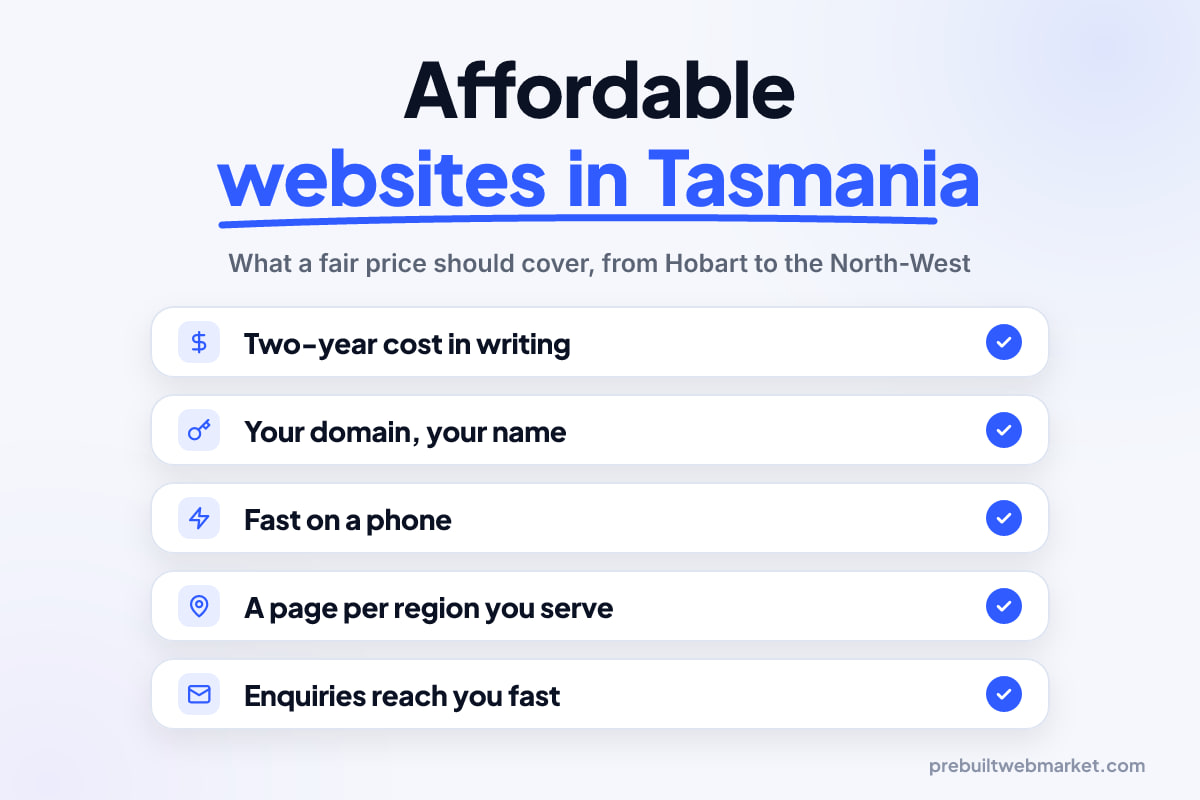
An affordable website in Tasmania is one whose total cost over the first two years is clear, that loads fast on a phone, sits on a domain in your name and turns visitors into enquiries. DIY builders cost least in cash but most in your time; agencies cost most. A prebuilt site from PrebuiltWebMarket costs US$97 a month plus US$297 setup and launches in about 7 days.
Key takeaways
- Judge the price over two years, not the first invoice: hosting, edits, renewals and your own hours are where cheap websites get expensive.
- Your domain should be registered in your business name with your ABN, so you keep it if you change provider.
- Tasmanians search by town and region, so give Greater Hobart, Launceston and the North-West their own pages if you genuinely serve them.
- Most service businesses do not need an online store. If you do need a cart, stock and shipping, use a dedicated ecommerce platform.
- Show prices including GST, keep a privacy policy and keep your hosting and domain receipts for your tax agent.
- A prebuilt website costs US$1,461 in the first year on our Launch plan with monthly billing, or US$1,267 paying yearly.
In this article
- How much do affordable websites in Tasmania cost?
- Why cheap websites in Tasmania often cost more later
- What a fair price for a small business website should include
- Building for how Tasmanians search: Hobart, Launceston and the North-West
- Do you need an ecommerce website in Tasmania?
- The Australian rules your small business website must get right
- Speed and hosting: the hidden cost of a slow website
- Getting found on a budget: local SEO and AI search
- Following up enquiries when you are on the tools
- A first-year budget for a Tasmanian small business website
- Mistakes that make a cheap website expensive
- How PrebuiltWebMarket helps Tasmanian businesses
- Your next step
- Frequently asked questions
Affordable websites in Tasmania range from a DIY builder you pay for monthly, to a freelancer’s one-off fee, to an agency build costing several thousand dollars, to a prebuilt site on a monthly plan. The cheapest first invoice is rarely the cheapest website. What makes a site affordable is a clear total cost over two years, a domain in your name, fast pages on a phone and enquiries that reach you, without paying for the same site twice.
This guide is for owners of small service businesses in Hobart, Launceston, Devonport and the towns between them who want a good website without an agency budget. It explains what each route really costs, what you should get for the money, the Australian rules a small business website must get right, and how to be found by customers searching from Kingston to Burnie or from the mainland before a trip.
How much do affordable websites in Tasmania cost?
Affordable websites in Tasmania usually cost somewhere between a few hundred dollars and a few thousand in the first year, depending on who builds the site and how much of the work you do yourself. The table below sets out the five common routes. Prices for other providers are typical ranges, not quotes, because every provider prices differently.
| Route | Typical first-year cash cost | Your time | Who fixes it when it breaks |
|---|---|---|---|
| DIY website builder | Lowest: a monthly subscription plus domain | High: many evenings of setup | You |
| Cheap freelancer site | A few hundred to a few thousand dollars, plus hosting | Medium | The freelancer, if still available |
| Local agency build | Usually several thousand dollars or more | Medium | The agency, often billed per hour |
| WordPress on cheap hosting | Low to medium, plus plugins and updates | High | You or a developer |
| Prebuilt website on a plan | US$1,461 on our Launch plan, hosting and edits included | Low | The provider, within the plan |
The pattern is simple. The less you pay in cash, the more you usually pay in your own hours, and hours spent fiddling with a site on a Sunday night are hours not spent quoting or doing paid work.
What the first invoice hides
The first invoice for a cheap website often covers design only. Hosting, an SSL certificate, backups, email, plugin licences and the domain renewal can arrive as separate bills. Changes after launch are frequently charged by the hour. Ask any provider for a written figure covering two full years, including at least four small edits, and compare that number rather than the headline price.
Why the second year matters
The second year shows whether a website was affordable. A DIY site costs the same subscription again plus your time. A freelancer site may need a rebuild if the person moves on or the theme stops being updated. A prebuilt plan costs the monthly fee without a second setup fee. Our guide to how long a business website takes to build shows how the time cost differs by route.
Why cheap websites in Tasmania often cost more later
Cheap websites in Tasmania tend to cost more later for four reasons: the owner does not control the domain, the site is slow on a phone, nobody is responsible for changes, and the site was never set up to produce enquiries. Each one is easy to check before you pay.
The domain is in someone else’s name
If a freelancer or agency registers your domain in their own account, they control your web address and the email that runs on it. When the relationship ends, getting it back can take weeks. Make sure the registrant is your business, using your ABN, and that you have your own login. On our plans, the domain is always registered in your name.
The site is slow on mobile data
Many Tasmanian customers search on a phone, sometimes on patchy coverage outside the bigger towns. A heavy theme with large images and slider plugins can take several seconds to show anything. Google’s Web Vitals guidance on web.dev sets a good Largest Contentful Paint at 2.5 seconds or less, measured across 75% of visits. A cheap site that misses that badly loses people before they read your phone number.
Nobody owns the changes
Prices change, staff change and you add a service. If every edit means an invoice, or a login you have forgotten, the website drifts out of date and starts to cost you trust. An affordable website includes a set number of edits, or makes editing genuinely simple.
It looks fine but does not produce enquiries
A site can look good and still fail at its one job. Missing click-to-call buttons, a contact form buried on one page, no prices and no reviews all mean visitors leave without contacting you. That is the costliest kind of cheap.
What a fair price for a small business website should include
A fair price for a small business website should cover the design, hosting, security, a domain you own, working enquiry forms, basic search setup and a way to make changes. Use this checklist when you compare quotes from Hobart freelancers, Launceston agencies, DIY builders and prebuilt providers.
| Item | Why it matters | What to ask |
|---|---|---|
| Domain in your name | You keep your address and email if you leave | Who is the registrant? |
| Hosting, SSL and backups | Keeps the site up, secure and recoverable | Is it in the monthly price? |
| Mobile speed | Most local searches happen on phones | What score does the site get in PageSpeed Insights? |
| Enquiry forms that notify you | Leads reach you while you are on a job | Do forms send to email and SMS? |
| Basic on-page SEO | Titles, headings and structure Google can read | Is the site tested in Lighthouse? |
| Edits after launch | Prices and services change | How many edits are included? |
| Analytics | You can see what is working | Is Google Analytics set up? |
| No lock-in | You can leave if it is not working | Is there a contract? |
If a quote leaves out three or more of these, it is not cheap. It has simply moved the cost to later.
Where a DIY builder is the right answer
A DIY builder can be the right answer for a brand-new sole trader with more time than money, a simple offer and a willingness to learn. If you enjoy the work and keep it up to date, it can serve you well for a year or two. Our comparison of DIY builders against a prebuilt website goes through the trade-offs honestly.
Where an agency is worth paying for
An agency is worth paying for when you need something unusual: a custom booking system, integration with industry software, or a large multi-location brand. If that is you, budget accordingly and insist on owning the domain and the code. For most trades and local services, a proven layout does the job without the custom price, which our article on prebuilt versus custom websites explains in more depth.
Building for how Tasmanians search: Hobart, Launceston and the North-West
Tasmanians search by town and region, not by state, so an affordable website should give each area you genuinely serve its own page. A plumber in Glenorchy, a cleaner in Launceston and an arborist in the Huon Valley all win work from searches that name the suburb or town, such as “electrician Kingston” or “gutter cleaning Launceston”.
Greater Hobart
Greater Hobart is the largest market, and customers often search by suburb or by side of the river: the Eastern Shore, the northern suburbs, Kingston and the Channel. If you work across all of it, a single Hobart page with a clear list of the suburbs you cover, the jobs you do there and a few local reviews is a good start. Separate suburb pages make sense only where you can say something genuinely different about each.
Launceston and the Tamar Valley
Launceston and the Tamar Valley form a distinct market with its own businesses and loyalties. Many people there prefer a business that names Launceston and nearby towns rather than one that reads as Hobart-based. If you serve the north, say so in the heading of a dedicated page, not in a footnote.
The North-West Coast and smaller towns
On the North-West Coast, customers in Devonport, Burnie, Ulverstone and the towns around them look for businesses that will actually travel to them. State plainly where you go, how often, and whether a travel charge applies. Honest coverage builds more trust than a long list of place names.
Mainland visitors searching ahead
Tourism is a big part of the Tasmanian economy, and many visitors search before they arrive. If you run a restaurant, accommodation or a tour, your website is often the first impression a mainland visitor gets. Clear opening hours, a menu or room information and a fast booking path matter more than an elaborate design. You can browse our restaurant website designs and accommodation and hotel website designs for examples of how that is laid out.
Google’s guidelines for representing your business also shape this. If customers do not visit your premises, you list a service area rather than show your address, PO boxes and virtual offices are not accepted, and the service area should stay within about two hours’ drive of your base. If you are in Hobart and also claim the North-West Coast, check that against the guideline before you add it to your profile or your website.
Do you need an ecommerce website in Tasmania?
Most Tasmanian service businesses do not need an ecommerce website. They need customers to see what they do, what it roughly costs and how to book or ask for a quote. A full online store, with a cart, stock levels, shipping rules and payments, is a different and more expensive kind of site to run.
We should be clear about our own offer here: PrebuiltWebMarket builds lead-generation websites for service businesses, with enquiry, quote and booking forms. We do not build online stores. If you sell physical products to customers across Australia, a dedicated ecommerce platform is the right tool, and you should budget for product photography, shipping and the time it takes to keep stock accurate.
Signs you need a real online store
You probably need a store if most of your revenue comes from products rather than services, customers expect to pay at the moment they decide, and you can ship reliably. Producers, makers and food businesses often fit this. Freight from Tasmania to the mainland crosses Bass Strait, so be honest in your checkout about delivery times and costs before customers find out the hard way.
Signs you only need enquiries
You only need enquiries if each job needs a quote, a site visit or a conversation first. Cleaners, tradies, arborists, removalists, clinics and professional services all fall into this group. For them, clear starting prices, a short quote form and a fast reply win more work than a checkout button.
The Australian rules your small business website must get right
A small business website in Australia must show honest prices, handle personal information properly and sit on a domain you are entitled to hold. None of this is expensive, but a cheap website often skips it. The table below summarises the main points; confirm the detail for your business with the relevant body or your adviser.
| Area | What it means for your website | Who sets it |
|---|---|---|
| Domain eligibility | A .com.au domain needs an Australian presence, usually an active ABN or ACN | auDA |
| Price display | Consumer prices shown as a total including GST and unavoidable fees | ACCC |
| Privacy | Many small businesses are exempt, but there are important exceptions | OAIC |
| Tax treatment | Running costs and build costs are treated differently | ATO |
Domains and your ABN
auDA, which administers .au domain names, explains on its page about .com.au domain names that .com.au is for businesses with a verifiable Australian presence, and an active ABN or ACN is the usual way to show it. You also need to keep meeting the rules: if your ABN is cancelled, you can lose the right to hold the name. Register the domain under your own business, not your web designer’s.
Showing prices with GST included
The ACCC’s guidance on price displays says that when you advertise a price to consumers, you must show the total as a single figure, including GST and any unavoidable fees. If your website lists “from $180” for a service, that figure should already include GST. Prices shown only to other businesses do not need to include GST, but most service sites speak to households.
Privacy policies
The OAIC explains in its small business privacy guidance that most businesses with an annual turnover of $3 million or less are not covered by the Privacy Act. There are exceptions, including businesses that provide a health service and hold health information, and businesses that trade in personal information. Even if you are exempt, a short privacy policy explaining what your enquiry form collects and why is good practice and builds trust.
Website costs at tax time
The ATO’s ruling on the deductibility of commercial website expenses (TR 2016/3) separates running costs from build costs. Periodic domain registration fees and hosting are generally deductible when you pay them, while the cost of developing a website is generally capital and depreciated unless an immediate deduction applies. Keep your receipts and let your registered tax agent decide how your own website costs are claimed.
Speed and hosting: the hidden cost of a slow website
A slow website costs you enquiries you never see, because people leave before the page loads and simply call the next business. Speed comes mostly from how the site is built and hosted, which is why the hosting line on a cheap quote deserves a closer look.
What good looks like
Google’s Core Web Vitals measure loading, responsiveness and visual stability. The web.dev Web Vitals article sets the good thresholds at a Largest Contentful Paint of 2.5 seconds or less, an Interaction to Next Paint of 200 milliseconds or less, and a Cumulative Layout Shift of 0.1 or less, each measured at the 75th percentile of visits.
How to test your current site
Open PageSpeed Insights, enter your home page address and look at the mobile result, not the desktop one. Then open your site on your own phone, on mobile data, standing outside. If it takes more than a few seconds to show your phone number, your customers are waiting too. Our article on website speed for local businesses explains the usual causes and fixes.
Why cheap hosting is a false saving
Budget shared hosting can be fine for a light site, but slow servers, missing backups and a single plan shared with hundreds of other sites cause the problems owners notice only when something breaks. Hosting that is fast, secure and backed up daily costs more than the cheapest plan, but less than a lost week of enquiries.
Getting found on a budget: local SEO and AI search
Getting found locally on a small budget comes down to a complete Google Business Profile, a website with clear pages for your services and towns, consistent business details and genuine reviews. SEO (search engine optimisation) is the work of making those pages easy for Google to understand and rank. None of it requires a large monthly retainer to start.
The first four steps
- Claim and complete your Google Business Profile, with the right category, hours, service area and photos.
- Give each main service and each region you serve its own page on your website, written in plain English.
- Keep your business name, address and phone number identical on your site, your profile and directories.
- Ask every happy customer for a Google review, and reply to the ones you get.
Showing up in AI answers
More people now ask ChatGPT, Gemini or Google’s AI Overviews which local business to call. These tools favour pages that state facts plainly: what you do, where, for whom and for roughly how much. This is often called AEO (answer engine optimisation) and GEO (generative engine optimisation), and our plain-English guide to AEO and GEO explains both. A clear FAQ section on your website helps with both Google and AI tools.
Why a small market can help you
A smaller market means fewer competitors with well-built websites, so a fast, well-structured site with honest local pages can stand out sooner than it would in Sydney or Melbourne. That is not a promise of rankings, and nobody can honestly make one, but the basics are cheap and they build on each other over time.
Following up enquiries when you are on the tools
A website enquiry is only worth something if you answer it before the customer rings someone else. For a sole trader up a ladder in Sandy Bay or under a house in Prospect, that is the hard part. An affordable website should at least send each enquiry to your phone by SMS as well as email, so you can reply between jobs.
A simple reply routine
Reply to every enquiry the same day, ideally within the hour. A short text saying you got the message and when you will call back keeps the customer from moving on. Save two or three standard replies on your phone for the jobs you get most often.
When automation is worth it
Once enquiries arrive faster than you can answer them, a CRM (customer relationship management system) can send an instant reply, text back missed calls and remind you about quotes you have not chased. Our GoHighLevel CRM service does this on the Scale plan at US$497 a month, but most new businesses should start with fast manual replies and add automation later.
A first-year budget for a Tasmanian small business website
A realistic first-year budget for a small business website in Tasmania covers the site itself, the domain, your time and a little for photos. Our own plans are priced in US dollars, with the same US$297 setup on every plan. The chart below shows the first-year cost of each plan with monthly billing.
- Launch (US$97 × 12 + US$297 setup)$1,461
- Growth (US$297 × 12 + US$297 setup)$3,861
- Scale (US$497 × 12 + US$297 setup)$6,261
Prices in US dollars. Hosting, SSL, backups and monthly edits are included on every plan.
Source: PrebuiltWebMarket pricing, 2026
The Launch plan covers what most small service businesses need in year one. Growth and Scale add the SEO blog package and the CRM for owners ready to invest in more search visibility or faster follow-up.
Monthly or yearly billing
Paying yearly costs less, and the setup fee is paid once. The next chart compares the Launch plan over two years on each billing option.
- $1,461Year 1, monthly
- $1,267Year 1, yearly
- $1,164Year 2, monthly
- $970Year 2, yearly
Year 1 includes the US$297 one-time setup fee. Prices in US dollars.
Source: PrebuiltWebMarket pricing, 2026
Over two years, yearly billing on the Launch plan comes to US$2,237 against US$2,625 paying monthly. Monthly billing costs more but lets you leave at any time, which is worth something if you are testing whether a website pays for itself.
Other costs to plan for
Set aside a little for the domain registration, a few good photos of your work, your team and your vehicle, and an hour or two to write your service descriptions. Real photos taken around your own area do more for trust than stock images of somewhere else.
Mistakes that make a cheap website expensive
The mistakes that make a cheap website expensive are mostly about ownership, honesty and follow-up rather than design. These are the ones we see most often when owners come to us after a first site that did not work.
- Letting someone else own the domain. Fixing it later takes time you will not have when you need it.
- Buying on the first invoice. Compare two-year totals, including edits and renewals.
- Listing every town in Tasmania. Only claim the areas you genuinely serve; vague lists read as spam to people and to Google.
- Hiding prices completely. Starting prices including GST filter out poor-fit enquiries and build trust.
- Building an online store you do not need. A shop adds cost and upkeep that a quote form avoids.
- Forgetting the phone. Test every page on a phone, on mobile data, before you pay the final invoice.
- Never answering the form. A website that sends enquiries to an inbox nobody checks is worse than no form at all.
A ten-minute check of your current website
Open your site on your phone and time how long it takes to show your phone number. Tap the call button. Fill in your own enquiry form and see how long the notification takes to reach you. Search Google for your main service and your town. If any of these fail, you know where your money should go first.
How PrebuiltWebMarket helps Tasmanian businesses
PrebuiltWebMarket sells proven, prebuilt websites for local service businesses in Australia and the United States, customised with your logo, colours, services, prices and the towns you serve. Because the design and pages already exist and work, a Tasmanian site can launch within 7 business days of receiving your content.
Every plan includes hosting, SSL, daily backups, a mobile-first build and lead forms that go to email and SMS. We guarantee a 100/100 on-page SEO score and a 95+ PageSpeed performance score at launch, a 30-day money-back on your first month and no contract. Your domain is registered in your name. You can click through a real example, such as the Harbour City Removals demo from Sydney, to see Australian spelling, phone formats and service-area pages at work, or browse our removalist website designs and tree service website designs. Plans start at US$97 a month, and you can see every inclusion on our plans and pricing page.
Your next step
Start by checking what you have. Run your current site through the ten-minute check above, confirm who owns your domain, and write down what you pay each year in total. If the numbers or the results are not good enough, look at the websites we build for Tasmanian businesses, compare the routes on our website options comparison, or book a free call with our team and we will walk you through the designs for your industry and a clear two-year price.
Sources
Frequently asked questions
How much does an affordable website cost in Tasmania?
It depends on the route. A DIY builder has the lowest cash cost but takes many hours of your time. A freelancer typically charges a one-off fee plus hosting, and an agency usually charges several thousand dollars or more. A prebuilt website from PrebuiltWebMarket costs US$97 a month plus a US$297 one-time setup fee, which is US$1,461 in the first year, with hosting, SSL and 3 edits a month included.
Are cheap websites in Hobart worth it?
Some are, if the low price covers what matters: a fast mobile site, your own domain, working enquiry forms and someone to make changes. Many cheap websites in Hobart leave out hosting, edits or ownership of the domain, so the true cost appears later. Ask for the total two-year cost and who owns the domain before you pay anything.
Can I get an ecommerce website in Tasmania from PrebuiltWebMarket?
No. We build lead-generation websites for service businesses, with enquiry, quote and booking forms, not online stores with a cart and checkout. If you sell products online and need stock, shipping and payments, a dedicated ecommerce platform is the better tool. Many Tasmanian service businesses that think they need a shop actually need clear prices and a fast enquiry form.
Do I need a .com.au domain for my Tasmanian business website?
You do not have to, but most Australian customers trust a .com.au address. auDA, the body that runs .au domains, limits .com.au to businesses with an Australian presence, and an active ABN or ACN is the usual way to qualify. Register it in your own business name so it stays yours if you change web provider.
Is website hosting included in an affordable website?
It should be stated clearly either way. Some cheap websites quote only the design and leave hosting, SSL and backups as separate monthly bills. Our plans include premium hosting, SSL and daily backups in the monthly fee. Whatever you choose, ask where the site is hosted, who renews it, and what happens to it if you stop paying.
Can I claim my website as a tax deduction in Australia?
Often, but how depends on the cost. The ATO treats running costs such as hosting and periodic domain registration as deductible in the year you pay them, while building a website is generally a capital cost that is depreciated unless an immediate deduction applies. Rules and thresholds change, so confirm your situation with your registered tax agent.
How long does it take to get a small business website live in Tasmania?
A custom agency build often takes one to three months, and a DIY site takes as long as your evenings allow. A prebuilt website is already designed and built, so it only needs your details, photos, services and towns. PrebuiltWebMarket launches within 7 business days of receiving your content, or your first month is free.
Does a small Tasmanian business need local SEO?
Yes, and a smaller market can work in your favour, because fewer competitors have well-built websites. Complete your Google Business Profile, give each region you genuinely serve its own page, keep your name, address and phone the same everywhere, and ask happy customers for reviews. Nobody can guarantee rankings, but these basics are cheap and they compound.
Should my website show prices if I am a tradie in Tasmania?
Showing starting prices or typical ranges usually helps, because people compare several businesses before they call. If you show prices to consumers, the ACCC expects the total price including GST and any unavoidable fees. Explain what changes the price, such as access, distance or materials, so customers know the final quote may differ.